
FeppsX Spotlight
Dr. Latha Karthigaa on Building AI Governance That Enables Innovation
AI governance is no longer simply a compliance conversation. Dr. Latha Karthigaa on what organisations need before scaling AI, why governance accelerates innovation, and the overlooked risk of shadow AI.
FeppsX Spotlight · August 2025
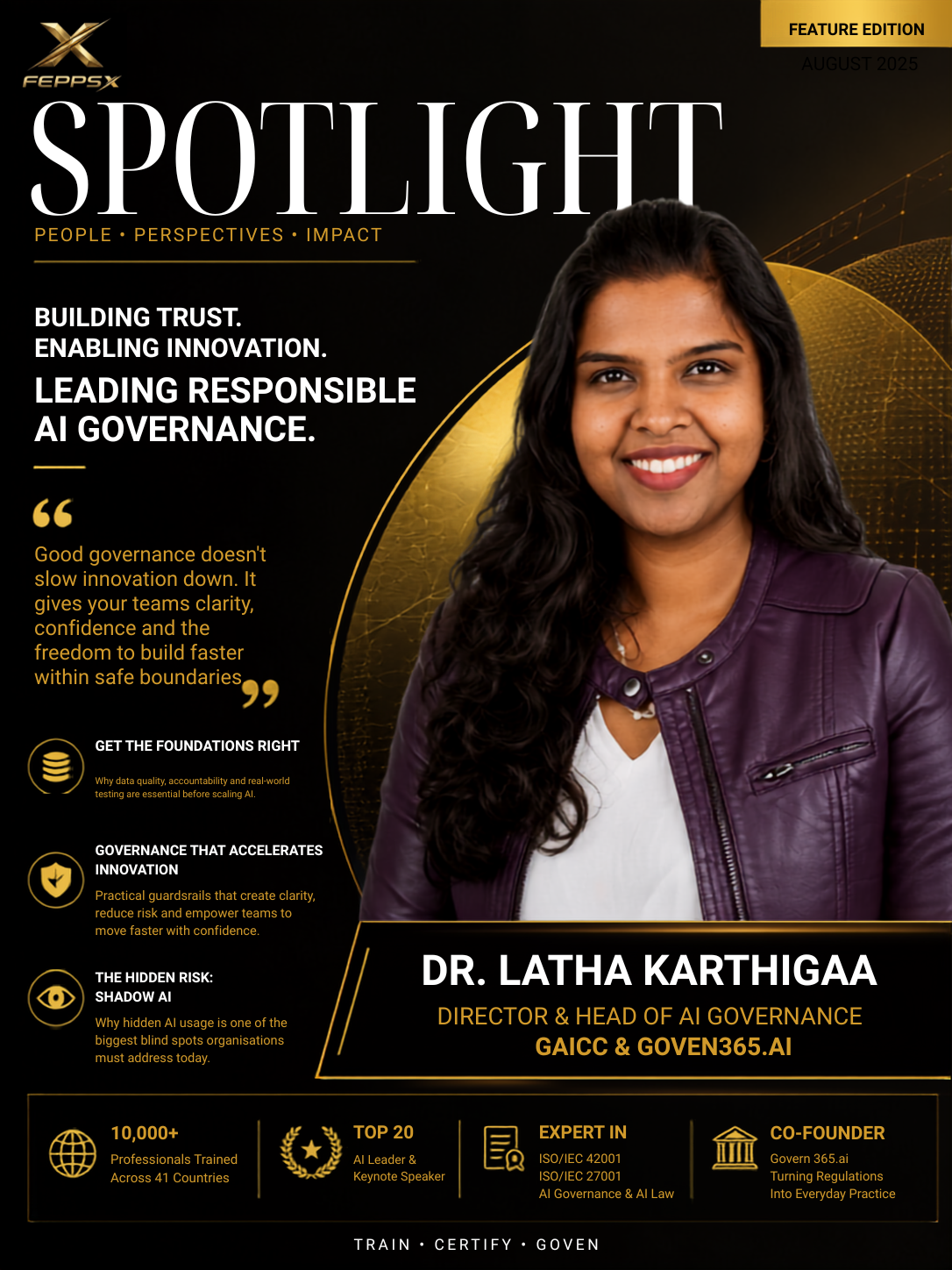
Featured in this edition
Dr. Latha Karthigaa
Director & Head of AI Governance
Global AI Certification Council (GAICC)
Also associated with Govern365.ai

Organisation of the featured individual. Shown as an affiliation credit only.
AI governance is no longer simply a compliance conversation. As organisations move from experimenting with artificial intelligence to embedding it into everyday operations, the question is becoming much more fundamental: how do we innovate quickly while ensuring AI remains safe, responsible, transparent and accountable?
For Dr. Latha Karthigaa, Director and Head of AI Governance at the Global AI Certification Council (GAICC), the answer begins with getting the fundamentals right.
GAICC has trained more than 10,000 professionals across 41 countries in ISO/IEC 42001, ISO/IEC 27001, and specialist AI governance and AI law credentials. Dr. Latha is also the co-founder of Govern365.ai, a platform focused on turning regulatory frameworks into practical, everyday governance.
At the heart of her work is a straightforward ambition: to make AI governance practical, accessible and trusted, so that people can use AI with accountability and confidence.
In this FeppsX Spotlight, Dr. Latha shares her perspective on what organisations need to establish before scaling AI, why governance can actually accelerate innovation, and why “shadow AI” may be one of the most overlooked risks facing organisations today.
Start With the Foundations, Not the Hype
As AI capabilities advance rapidly, organisations are under increasing pressure to adopt new technologies. But according to Dr. Latha, one of the biggest mistakes organisations make is moving too quickly without first understanding what could go wrong.
“Many organisations rush to build exciting AI technology, but they skip the basics,” she explains.
AI systems can introduce bias, models can change over time, and their outputs can have real consequences for people. At the same time, organisations need to consider whether their AI systems are safe, fair and compliant with applicable laws and regulations.
For Dr. Latha, if there is one foundation organisations should prioritise before scaling AI, it is data quality.
AI runs on data. Every output depends on it. If the data is wrong or biased, the AI will be wrong too.
But good data alone is not enough. Organisations also need clear accountability — someone who owns the responsibility for the AI system and its outcomes.
She points to real-world AI deployments as a reminder that systems that perform well in controlled environments may behave very differently when exposed to the complexity of everyday life.
The lesson is simple: AI needs to be tested in the real world, not just in a clean laboratory environment.
Governance Should Be a Guardrail, Not a Roadblock
One of the most persistent concerns surrounding AI governance is that regulation and controls could slow down innovation.
Dr. Latha sees the issue differently.
If you look at just the next two months, yes, governance can feel like it is slowing you down. But if you look two years ahead, when you are trying to scale and build something real, governance actually speeds innovation up.
The reason is clarity.
When organisations understand what they can do, what they should not do, and where the boundaries lie, teams can make decisions with greater confidence.
For Dr. Latha, effective governance also does not need to begin with complicated compliance checklists.
Instead, organisations can start with a few fundamental human-centred questions:
Are the people using this AI safe?
Is it fair?
Is it transparent?
Does it protect their privacy?
And perhaps most importantly, is the technology safe for people not only technically, but also mentally, physically and psychologically?
This human-centred approach offers a different way of thinking about governance.
Dr. Latha describes it through the analogy of a mountain road.
Guardrails do not stop the driver from moving forward. They give the driver confidence to move faster without fear of falling off the edge.
In much the same way, effective AI governance creates boundaries within which organisations can innovate confidently.
The Risk Organisations Cannot See: Shadow AI
As AI tools become increasingly accessible, another challenge is emerging inside organisations: employees using AI tools without the knowledge of their IT, security or governance teams.
Dr. Latha describes this as “shadow AI.”
The challenge is straightforward. If an organisation does not know which AI tools its employees are using, it cannot properly understand or measure the risks associated with that usage.
And simply banning these tools is unlikely to solve the problem.
Bans do not work. People will use them anyway.
Instead, organisations need to focus on awareness, education and practical policies.
Employees should understand the fundamentals of data protection, how information may be handled by different AI platforms, and what types of organisational information should or should not be shared with AI systems.
The goal is not to prevent people from using AI.
It is to help them use it safely and responsibly.
As AI adoption continues to expand, this becomes increasingly important for organisations operating across different regulatory environments. For businesses serving markets such as the European Union and the United States, understanding regulatory expectations and managing AI-related risks is becoming an increasingly important part of responsible growth.
A Future Built on Trust
Across all three areas — AI readiness, innovation and shadow AI — Dr. Latha's perspective points towards the same principle:
AI governance should enable responsible innovation, not prevent innovation.
The organisations that succeed will not necessarily be those that adopt every new AI tool first. They will be those that understand how to build the right foundations, establish accountability, create practical guardrails and develop an informed workforce.
As AI becomes more deeply embedded in organisations and society, governance will increasingly become part of how trustworthy innovation is built.
And perhaps the most important shift is cultural: moving from seeing governance as something that comes after innovation, to recognising that good governance is part of responsible innovation itself.
About Dr. Latha Karthigaa
Dr. Latha Karthigaa is Director and Head of AI Governance at the Global AI Certification Council (GAICC), an organisation focused on AI governance certification and professional development.
GAICC has trained more than 10,000 professionals across 41 countries in ISO/IEC 42001, ISO/IEC 27001, and specialist AI governance and AI law credentials.
Dr. Latha is also a co-founder of Govern365.ai, a platform focused on translating regulatory frameworks into practical governance.
Her work centres on making AI governance practical, accessible and trusted, helping organisations and professionals approach AI with greater accountability and confidence.
Learn more about GAICC: www.gaicc.org